A Review Without Mercy: The Sea Eagle Packfish 7
June 5, 2026
version 1.0
What exactly is a "Packfish?"
Officially a "Packfish 7", a Packfish is a near-minimal personal inflatable boat marketed for fisherpersons. As the name might suggest, it is highly portable, and stripped of the accessories weighs in at about 28 pounds. That means, you can access places that would otherwise be unreachable. There are some limitations, however, and we will get to those shortly.
The Packfish is made from a stitched, fiber-reinforced vinyl floor material, bonded to a tough outer fabric that wraps around to a synthetic zipper. Undoing that zipper, which is something you really don't want to do, opens the fabric "doughnut" that contains the two inflatable chambers, stacked one above the other. Ports through the fabric material provide access to two "HR" twist inflation valves typical of inflatable craft. There are two carry handles that double as oarlocks of sorts. Two zipped-flap accessory bags are bonded to the fabric on top of the tubes, and two "rod holders" take up floor space at the slightly narrower front end.
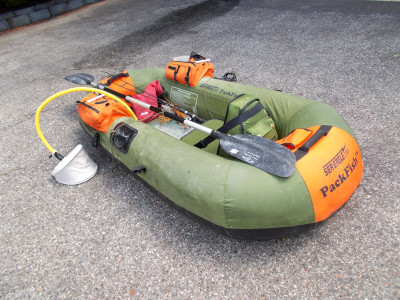
Inflated Packfish 7
Though you can find Packfish sold online at Amazon and many other online resellers, most years Sea Eagle will run a Packfish sale and you can get a really good deal buying from them direct. They are pretty good with incompetent buyers, and have demonstrated that they are serious about warranty support.
Do I know now what the H----- I'm talking about?
I think so. My comments here are based on logged fishing activities for over 120 trips that spanned several years and 3 separate Packfishes, one of which is still in service and doing well.
Are there optional accessories?
A floorboard is available as an option, but seriously, it is not optional. The floorboard adds 6 pounds weight.
Here is what my floorboard looks like. Now, imagine what would be left of your soft vinyl floor after subjecting it to this amount of wear.
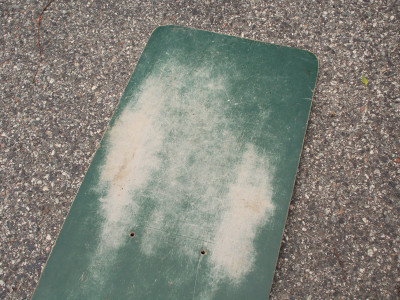
What my floorboard has dealt with
And I don't even wear shoes when I am in the boat!
On a personal comfort note, little drips of water will inevitably collect collect inside the boat, flowing around the edges and under the floorboard. If you don't have a floorboard, anything touching the bottom of the boat will get wet.
Standing is possible, but be very careful. The floorboard is absolutely required for this, or your floor seams will be ripped apart. While standing is helpful in special situations, in general, it is just asking for a wet kind of trouble.
Is a Packfish big enough?
To stay afloat, oh yes. To give a large person an adequate and comfortable space, probably not.
When it is fully inflated, the exterior measures 40 inches wide and 80 inches long. But what may be more important is that the interior measures 15 inches wide and 56 inches long.
I am 5 foot 7. I need one small water-resistant "river bag" for various accessories that don't fit the side compartments. I use one 3-pound anchor. With just this gear, and using the provided inflatable seat, there is barely enough room to extend my legs along the floorboard. I would expect somebody 6 foot 4 to be too cramped to operate comfortably for any length of time. If that sounds like you, consider some other model of Sea Eagle boat.
Is it safe?
Yes. It is compliance tested and certified for freshwater and light saltwater service, rated for one person and equipment to 300 pounds, or cargo to 225 pounds. Some people find this confusing: why are the passenger and cargo ratings so inconsistent? Well, that's because there are two different safety standards, with separate compliance testing. The two standards don't align. Just don't push any limits and you will be plenty safe.
Basically, it is as safe as your own lack of judgment allows. You must always wear personal flotation, a life jacket or life vest — that means at all times. If for no other reason, your local boating regulations probably require it. Even so, just stay away from any situations when you must contend with the wake of a large power boat, swift currents, or wind-driven surf.
What accessories are included?
Packfish boats are readily shipped by the usual parcel services. They come packed with: a pair of oars, an inflatable seat, and a carry bag with shoulder straps, and an air pump.
A pack bag? Cool. Is it good for packing?
No. The pack bag is only good for closet storage. There is no option for transporting the floorboard, accessories, and cargo. Even with a packed weight under 35 pounds, the tiny straps make it miserable to carry for any kind of distance, even 100 yards. Most people are going to hand-carry straight from the trunk of the car to the shore of the lake, and the bag is extraneous.
The boat fits the bag OK when it fresh out of the factory with everything folded just right and the air chambers absolutely empty. However, when you try to stuff the boat back in the bag later, the seams won't stand for it. The bag will not survive for long. (Mine didn't.)
Sea Eagle: We don't need this. A couple of straps for keeping the boat folded compactly would be sufficient for storage.
If you are REALLY serious about packing into hard-to-access places, consider investing in a foldable-collapsible one-wheel gardening wheelbarrow, and use a ratcheting tie-down strap. This combo has limitations, but I have gone off-road this way for distances of up to 2 miles.
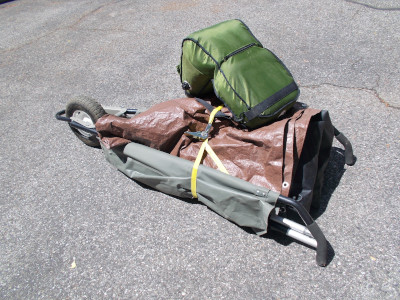
Packfish loaded up for transport
So what about the oars?
The oars are functional, but problematic. As I recall, I tried them for three trips. I was so frustrated that I switched to a two-piece kayak-style paddle with aluminum shaft and plastic blades. I have used that ever since.
I know that Sea Eagle had problems with their hard-plastic oar lock rings, and replaced them with flexible handles that double-duty as oar locks. The trouble is, these leave the oars pointing straight out to the sides, always interfering with fishing, with handles poking straight into the center of the boat, always interfering with everything else. Even after removing the oars, the oarlock-handles remain an annoyance for paddling. I have considered just cutting them off, but something is needed for carrying the boat.
Sea Eagle: I hope you are listening. Ditch the oars, go back to the wonderful side handles that you once had, and substitute a simple kayak paddle kit for the oar kit.
A word about propulsion in general: the oars or paddle can easily move you along in a relaxed manner at a lazy 1.0 MPH. If you paddle like mad and struggle hard, you can increase that to a brisk 2.0 MPH. And that is it. Think about the implications. Against a 2 MPH current, your maximum forward rate of travel is 0. With a 15 MPH wind, the maximum rate of travel against the wind is 0. These facts of life will limit what you can do. This is no fault of the boat, it is just the nature of things. Be realistic.
Can you use a motor?
No. And you wouldn't want to. Why would you ask?
How about the inflatable seat?
The inflatable seat does its job. Be sure to inflate fully, or there will be too much stress at the edges of the inflation valves, causing the fabric to pull away and cause a leak.
The main drawback is that the seat back is oversized. That is intentional, to push you forward to a position where you can operate the oars. But the side effect is that you lose about a foot of precious interior space. I think Sea Eagle people know their stuff when it comes to working with drop-stitch materials. After abandoning that "oars" idea, they could do better by redesigning the seat to conserve interior space.
For a while, I used an REI low-profile folding pack chair. It was a little tippy, but with care, I could ride a little higher, clear the annoying oarlock-handles easily, and reserve a little more floorboard room below me for gear. However, I found that too much stress was applied to floor seams at the edges of the floorboard, so I don't recommend this option.
I have also looked for a simple inflatable cushion. So far have not found anything suitable.
Are the air pumps any good?
Well mostly. They push air rather well. They using an adapter kit to attach to the Packfish's "conventional" HR twist valves, seat, and a various of other inflatable items you might have. You will want to become familiar with operating the "push and twist" stems in the center of the boat's valves — make sure you have the stem in the high position before inflating!
It takes me about 120 pump presses for each chamber; I have no trouble inflating in approximately 10 minutes. You only need to inflate to 1.5 PSI pressure, which is good because the provided pumps won't give much more than that. The boat will have a "reasonably firm but not hard" feel when fully inflated, so you don't need a pressure gauge, a good thing because Sea Eagle doesn't provide one.
The pumps have problems, however.
As delicate as a crappie's mouth, the plastic flex hose is exceptionally easy to tear, particularly near connectors. If that happens, it is all over: you are not repairing, and you are not fishing. So be extra gentle. Never lift the pump by the hose. Hold ONLY the end connectors, never the hose proper, while attaching or detaching to anything. Support the hose, so that it does not flop around while you are foot-pumping to inflate.
The second problem is that the air bladder material is held in place at the borders of the foot-pads by steel bands. Over time, these bands will loosen, the bladder material will pull past, and the air will leak around the seal. This failure is much more likely than any failure of the boat itself. I have gone through a couple of pumps like this. For my latest, I got myself a can of FlexSeal, which is generally crap but good enough for this purpose, and sealed up all of the edges at the bands. So far, good enough, no significant leaking.
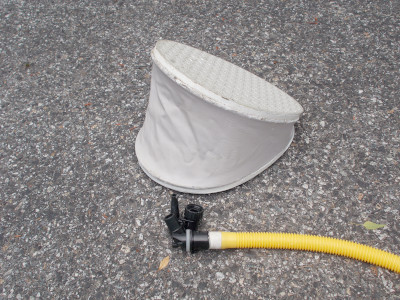
Preemptively sealing of air pump
Is this boat tough enough?
Mostly. It depends on the kind of abuse.
You do not need to worry about that you will scrape bottom over the sharp edge of a submerged rock and cut a gash that will sink the boat. Simply will not happen. The material is nearly impossible to cut through even with sharp shop tools. I know, because I tried after one of my boat failures.
It is theoretically possible to jam the barb of a fishhook into the upper fabric, but really hard to penetrate. You must penetrate completely to reach the air bladders, and then maybe cause a leak. This is another "take reasonable care and then don't worry" kind of issue. I have had hooks bite into the fabric plenty of times, but never anything close to a leak problem.
But that does not mean that a Packfish is indestructible. While the vinyl bottom material is near impossible to puncture, it is highly vulnerable to abrasion. Dragging across grass is not a worry, but dragging across sand or gravel? Serious bad news. Especially where edges of the floorboard push against the flexible floor material to create a pressure line. Scraping can slowly but surely carve away material until the embedded fabric is exposed, and you have a slow leak problem. I unfortunately had a trip cut short when I became very wet in all the wrong places. The hazard is easy to avoid: carry the boat, don't drag it!
Another serious no-no is trying to bull your way through floating mats of water weeds. There is a serious weakness at the seams of the floor material at the front and back of the boat. Embedded stitching at these locations pulls the material into a rounded shape. Every time time you bump into an obstruction, this puts a serious stress on that stitch work. If you intentionally elevate the stress, for example, by battling your way through lily pads, those seams will eventually weaken and split. I did not want to take any chances with my latest Packfish. I cut patches from patch material, obtained a high-quality PVC cement kit, and applied preemptive reinforcement to all of the outer corner seams before the first launch.
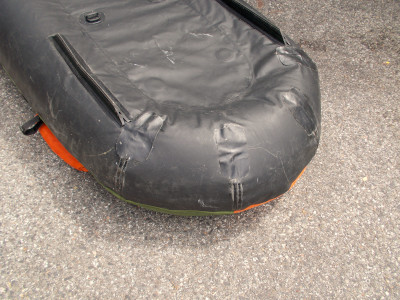
Packfish with preemptive corner patches
How long is the boat likely to last?
From my experience, about 40 outings. In general: treat you Packfish as if it is fragile, and it will be like indestructible. However, you can still expect that that there will be some kind of eventual failure at the seams along the bottom of the tub, and that is end of the line.
How well do the attached gear compartments work?
Not too bad. Packfish has two boat fabric zip compartments permanently mounted near the front end. My synthetic zippers are deteriorating, but so far have not failed. The built-in "cup holders" are just silly, like, who is going to bring cold beer to you out in the middle of the lake? The compartments are just the right size for holding two clear plastic compartmentalized gear boxes each. I still need to stash one waterproof "river bag" just beyond my toes at the end of the boat to keep a few larger items organized and dry.
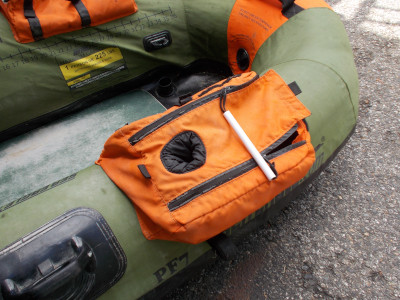
Integrated gear bags
I guess my main quibble about these compartments is that the zippers pull in the wrong direction. You need zippers closed, or contained gear is subject to unscheduled launch. But to get inside, you have to reach all the way to the far end of the boat and unzip toward you. That extra reaching makes access slow.
How well do the rod holders work?
Well, they do hold rods. The reason for holders is that you need them for trolling a line behind the boat, while your hands are occupied keeping the boat moving. But unfortunately...
- The rod holders are at the far end of the boat by your feet (necessarily I might add), which makes operating fishing gear impossibly awkward. For example, you can't spool out line and maintain motion at the same time.
- This boat is simply not suited for trolling. It is impossible to maintain any sort of consistent orientation, path, or speed, which makes trolling frustrating and ineffective.
If you are the kind of troll who only knows trolling, you should consider a different kind of boat.
Sea Eagle: Forget the useless rod holders. Instead, provide more low-profile attachment points.
Attachment points? For attaching what?
The most effective way to use this boat is to glide silently into position, then cast off to each side where the fish are hiding. But this boat is a bubble in the breeze. It easily drifts somewhere it shouldn't be before you can get your fishing started.
An anchor is essential. I recommend a 3 pound (1.5 KG) galvanized anchor. Use duct tape to hold the tines together — you don't need them when there is no serious wind or current, and you don't want to risk seriously snagging on anything. The weight alone is enough to keep you adequately in place, especially in silt or nice thick bottom weeds. Hardware store parachute cord will serve fine for the anchor line. I tie knots in the line every 5 feet, so I get a free sounding of depth while lowering the anchor.
With even the slightest breeze, a Packfish is going to spin around so that its anchor line points into the wind, whatever direction that happens to be. Usually, that faces you in the wrong direction to fish effectively. Consequently, you need a variety of tie points where your anchor line can be attached, on all corners and sides. Currently, the Packfish is seriously lacking in this department.
Well, if the Packfish is so terrible, then...
... why is it that I racked up so many trips with it? Well, because there really isn't anything out there to compare with it. No boat trailer or car-top rack needed for travel. I can just fold it into quarters, toss it in the back of my car, and head out. I am not restricted to busy "launch-for-fee" sites or major boat launches. I can launch in any suitable body of water that gives me 4 feet of accessible shore space and 5 inches of water depth. It is far safer and more stable than canoe or kayak craft. I can silently approach the most wary of fish, rather than trolling around all day waiting for them to come to me. I have learned to deal with the peculiarities. I can, if I wish, just raise the anchor and drift along silently to enjoy the day. And oh yes, I do catch plenty of fish.